


Temporary barricades are often necessary at concerts, festivals, sporting events, parades, and civic gatherings, but their appearance can feel plain or unfinished. By adding barricade covers, event organizers can turn standard crowd-control equipment into useful space for branding, directions, sponsor recognition, and visual screening while still maintaining clear physical boundaries.
Give Temporary Event Setups a More Finished Look
Large events depend on temporary infrastructure. Barricades, fencing, queue lanes, entry checkpoints, and restricted areas all serve practical purposes, but they can make a venue look highly functional rather than polished.
Covers help soften the appearance of exposed metal barriers and allow them to blend more naturally with the rest of the event design.
This can be especially useful around high-visibility areas such as entrances, VIP zones, ticket lines, sponsor areas, stage perimeters, and media locations.
A consistent design across these sections can make the overall setup look more deliberate without changing the basic role of the barricades.
Use Existing Barricades for Branding
Event planners often need to place branding throughout a venue without filling walkways with extra signs or displays.
Barricades already occupy prominent positions, which makes them useful locations for printed graphics.
Covers can feature:
- Event logos
- Venue names
- Sponsor branding
- Campaign graphics
- Municipal logos
- Event themes
- Promotional messaging
This approach allows organizers to use equipment that is already part of the layout instead of adding more freestanding structures.
It can work well at corporate events, festivals, sporting competitions, public celebrations, and ticketed venues.
Create Better Sponsor Exposure
Sponsors often expect visibility in areas where attendees naturally gather or pass through.
Barricades are frequently placed along entrance routes, spectator zones, queue lines, race courses, and event perimeters. Adding sponsor graphics to these locations can create repeated exposure throughout the event.
This can be particularly effective at:
- Running events
- Cycling races
- Parades
- Outdoor concerts
- Street festivals
- Sports tournaments
- Community events
Event organizers can also divide sections among different sponsors, depending on the layout and sponsorship agreements.
Support Wayfinding and Guest Communication
Crowded venues can be difficult to navigate, especially when guests arrive from several directions.
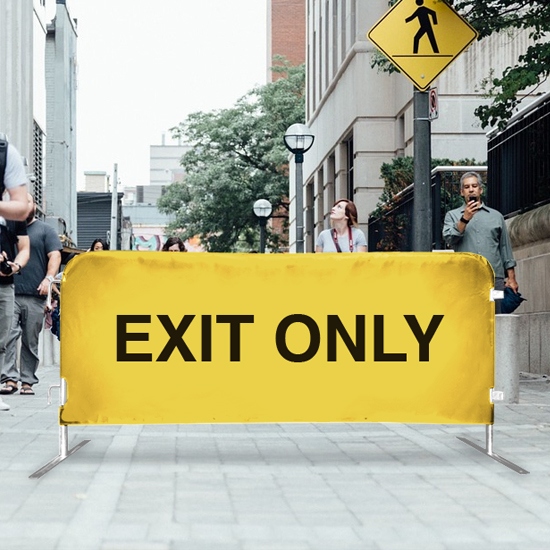
Covers can be used to reinforce important information throughout the event site. Short messages placed directly on barricades can help visitors identify where they should go.
Common examples may include:
- Entrance
- Exit
- VIP access
- Registration
- Staff only
- Security checkpoint
- Queue starts here
- Restricted area
These messages should complement official event signage rather than replace any required safety signs.
The advantage is visibility. Guests may notice a message displayed across a large barrier more easily than a small sign positioned nearby.
Help Separate Public and Operational Areas
Not every part of an event should be visible to attendees.
Production spaces, equipment storage, backstage areas, temporary offices, staff zones, and service areas may need some degree of visual separation.
Depending on the material and design, covers can help reduce direct views into these spaces.
This can make operational areas appear less distracting while also reinforcing that they are not intended for public access.
Organizers should still make sure covers do not interfere with security monitoring, ventilation, required sightlines, or emergency procedures.
Choose Designs That Are Easy to Read
A barricade cover should communicate quickly.
Attendees may only see it for a few seconds while walking through the venue, so overly detailed graphics or long messages may not be effective.
Clear logos, short phrases, large lettering, and simple visuals are generally easier to recognize.
Event planners should consider the distance from which the cover will be viewed as well. A design intended for a close-up queue area may differ from one placed along a parade route or race course.
Contrast and readability should be checked before final production.
Consider Weather and Installation Conditions
Outdoor events require extra planning.
Wind, rain, dirt, and repeated handling can affect how covers perform during an event. Organizers should make sure the selected material and attachment method are appropriate for the location.
Covers should be installed securely and checked before attendees arrive.
For longer events, staff may also need to inspect them periodically to make sure they remain properly positioned.
This is particularly important in exposed areas where wind conditions can change during the day.
Coordinate Covers With the Event Layout
Barrier graphics are most useful when they are planned alongside the full event map.
Organizers can identify locations where branding, navigation, sponsorship, or screening will provide the most benefit.
For example, branding may be most valuable near entrance areas, while directional messages may work better around queues and intersections.
Sponsor graphics may be placed along high-traffic routes or spectator areas.
Using covers selectively can prevent the venue from becoming visually crowded while still making good use of the available barrier space.
Make More Use of Crowd-Control Equipment
Crowd-control barricades already help define routes, separate spaces, and manage access. Adding covers gives organizers another way to support communication and presentation without introducing additional structures into the venue. Event planners, municipalities, venues, and security teams looking for practical event barrier accessories can explore available options from Epic Crowd Control for upcoming public and private events.
