



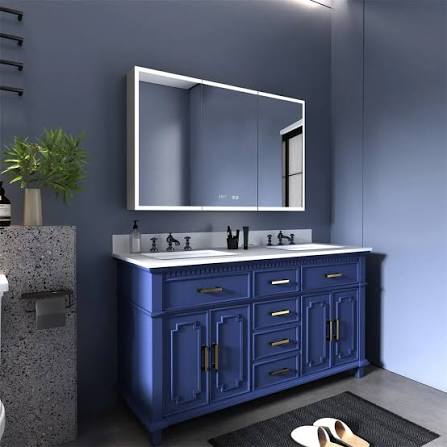
A standard medicine cabinet and an LED medicine cabinet look nearly identical from across the room, but the price gap between them can run several hundred dollars. That gap isn’t marketing markup. It reflects real differences in the electronics, wiring, and hardware packed into the lit version, and knowing what those differences actually do makes the upgrade decision much easier.
What the Premium Actually Buys
The jump in price on an LED version comes from three things: the light source itself, the electrical components that power it, and often a built-in outlet for charging devices at the mirror. None of that exists in a standard cabinet.
A few specific additions typically justify the cost difference:
-
Integrated LED strips or panels rated for high-humidity environments, not standard household bulbs
-
A dedicated low-voltage driver that steps down household current safely for the light source
-
Touch-sensor or app-based controls in place of a simple mechanical switch
-
In many models, a built-in 1800W outlet with USB-A or USB-C ports for razors, toothbrushes, or phones
Without these components, a cabinet is just a mirror over storage. With them, it becomes a more capable fixture, but only if the underlying specs hold up to daily bathroom conditions.
The Specs Worth Checking Before Paying the Premium
Not every lit cabinet on the market delivers a premium experience just because it has a light source. A handful of specifications determine whether the extra cost is well spent:
-
Color rendering index (CRI). Anything below 90 will render skin tone and color less accurately, which defeats much of the purpose of paying for built-in lighting.
-
Adjustable color temperature. A range from roughly 3000K to 6000K lets one fixture handle a warm evening routine and a brighter morning one without swapping bulbs.
-
Dimming range. A wide dimming range matters more day-to-day than raw brightness, since most routines don’t need maximum output most of the time.
-
Outlet certification. Any built-in electrical outlet should carry ETL or UL certification; this isn’t optional in a wet-area fixture.
-
Driver placement and ventilation. A driver mounted too close to the mirror surface without adequate airflow can shorten the light source’s lifespan in a consistently humid room.
Hardware quality still matters just as much as it does on a standard cabinet. Soft-close hinges, magnetic door catches, and a stainless steel or powder-coated frame all affect how the cabinet holds up over years of daily use, regardless of whether it lights up.
Installation Realities That Differ From a Standard Cabinet
Because power has to reach the fixture, installing an LED medicine cabinet involves a few extra steps compared to a plain mirror-front cabinet:
-
Electrical access. A hardwired version needs a junction box behind the wall, which is straightforward during new construction but adds labor cost during a retrofit.
-
Outlet placement for plug-in models. If the unit plugs into a standard outlet, that outlet needs to sit close enough to stay concealed rather than trailing a visible cord.
-
Dimmer switch compatibility. LED drivers don’t all play well with older dimmer switches; mismatched components can cause flickering or an audible buzz.
-
Weight considerations. The added electronics make these cabinets heavier than standard versions, so wall anchors need to be rated accordingly, especially on larger sizes.
-
GFCI requirements. Any built-in outlet near a sink needs to sit on a GFCI-protected circuit per most electrical codes, which a licensed electrician should confirm during installation.
A DIY-friendly model with a plug-in design can often be swapped in an afternoon, but anything requiring new wiring is worth having a licensed electrician handle, particularly in an older home.
Deciding Whether the Upgrade Makes Sense
The premium isn’t the right call for every bathroom. A few practical questions help decide:
-
Does the current lighting already provide even, accurate illumination at the mirror, or does it rely on overhead or side fixtures that cast shadows?
-
Will a built-in outlet actually reduce daily friction, or is there already a convenient outlet nearby?
-
Is the bathroom used heavily enough by one or two people to justify the added cost, or is it a low-traffic guest bath?
Retailers such as Allsumhome list CRI, wattage, and outlet specs directly on each product page, which makes it possible to compare the actual electrical details side by side rather than judging by price alone.
The Bottom Line
The added cost of an LED medicine cabinet is easy to justify when the specs behind it are solid: a high CRI rating, a usable dimming range, certified electrical components, and hardware built for a humid environment. It’s much harder to justify on a cabinet that only offers a light source without the supporting quality behind it. Checking those specs before purchase is what determines whether the upgrade earns its price difference over the years it stays on the wall.
