



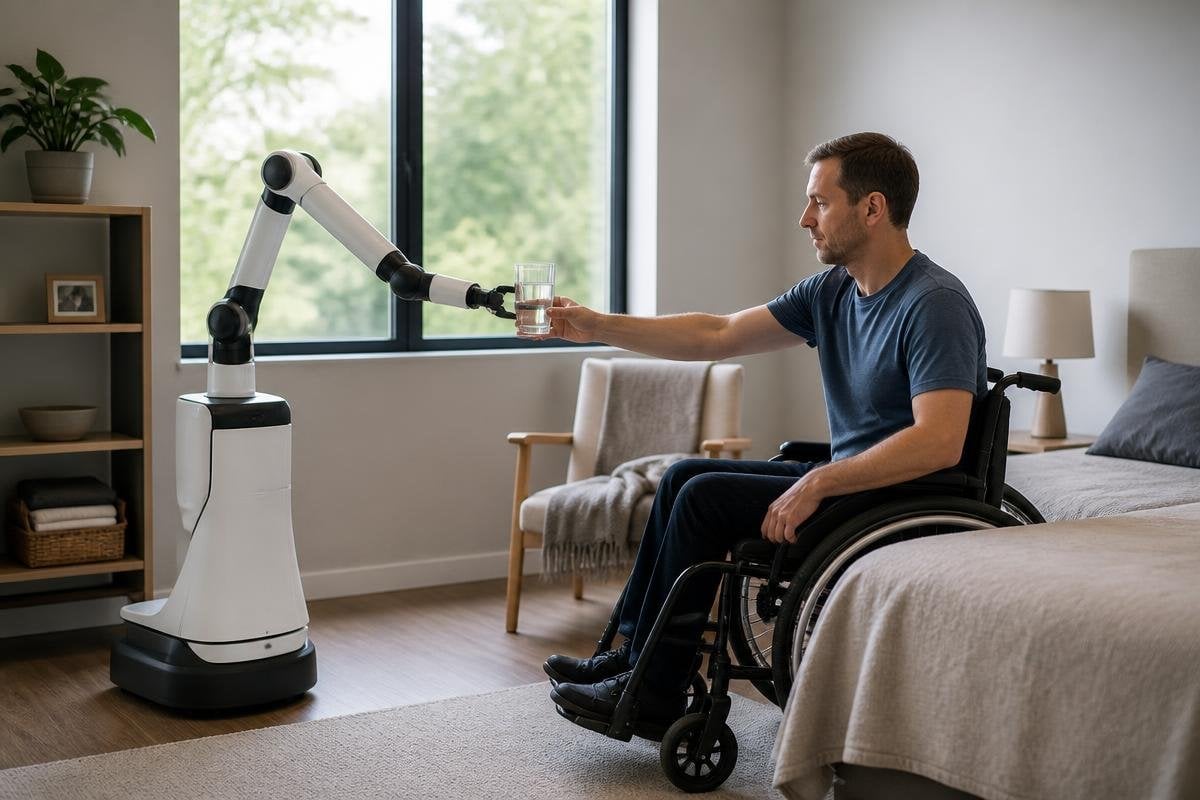
A robot can help with a small task that blocks a much larger part of daily life: reaching a shelf, opening a door, or moving from a chair to a bed.
The useful test is practical. Does the system give a person more control, less strain, or a safer way to complete a task?
- Robotic arms can handle reach and grip tasks from a wheelchair.
- Exoskeletons can support leg movement during standing or walking practice.
- Voice, switch, and gaze controls can give people more ways to command a robot.
Where robots can help
Assistive robots work best when they handle a clear physical job. A robotic arm mounted to a wheelchair could pick up a cup, move an object from a table, or press a button. The person still chooses the task, while the robot supplies reach, grip, or movement.
That control method matters. A person may use a joystick, voice command, switch, head movement, or eye gaze. The system must turn that input into safe motion without making the person repeat the command several times.
A mobile robot can also move items around a home or care setting. It may carry food, medicine, books, or a phone from one place to another. The benefit comes from the task it removes, not from the robot’s appearance.
The main types of assistive robots
Robotic arms focus on reach and handling. Their end effector, the part that touches an object, may use a gripper, suction cup, or another tool. The arm needs to sense contact so it can hold a cup without crushing it or dropping it.
Powered exoskeletons support movement around the legs, hips, or upper body. They use motors and sensors to add force as a person stands, steps, or trains a movement. A system that works in a clinic may still need changes before it suits a home, where floors, doors, and furniture vary.
Social and communication robots support interaction rather than lifting. They may help a person follow a routine, call for assistance, or take part in a remote conversation. These tasks still need careful design because a wrong prompt or missed command can leave the person waiting.
For readers comparing products, Robot24.com is a robotics news platform whose coverage is relevant when you need source-based reporting on assistive machines, companies, and research.
The limits that decide whether a system works
A robot must fit the person’s body, home, controls, and daily tasks. A wheelchair arm that reaches a kitchen counter may have trouble with a low drawer. A leg support that works on a flat clinic floor may need different control for a ramp or uneven ground.
Safety adds another layer. The robot needs a clear stop control, limits on speed and force, and a way to recover when a sensor loses track of an object. The person also needs to understand what the robot will do before it moves.
Cost and upkeep matter just as much. Batteries need charging, software may need updates, and a damaged gripper can stop the system from doing its job. A product with a long setup process may place too much work on the person who needs it.
The strongest opposing view is that trained staff or a simpler device may solve the task better. That can be true. A grabber, ramp, adapted handle, or home change may cost less and require fewer repairs.
I’d judge an assistive robot by the task it gives back to the person, not by how human the machine looks.
A practical buying checklist
Use these questions before you compare models or ask for a trial:
- Name the task: Write down the exact action, such as picking up a cup or opening a drawer.
- Test the controls: Check whether the person can command the robot with their preferred input method.
- Check the space: Measure door widths, table height, floor changes, and the robot’s reach.
- Review safety: Find the stop control, force limits, recovery steps, and supervision needs.
- Price the full setup: Include fitting, training, charging, repairs, software, and replacement parts.
A trial should use the person’s real objects and normal route through the home or care setting. A staged demonstration can show that a robot moves; a daily task shows whether it helps.
The next useful evidence is specific: the robot model, the task tested, the control method, the setting, and the result. Until those details are available, treat broad claims about assistive robots as a starting point, not a reason to buy.
