



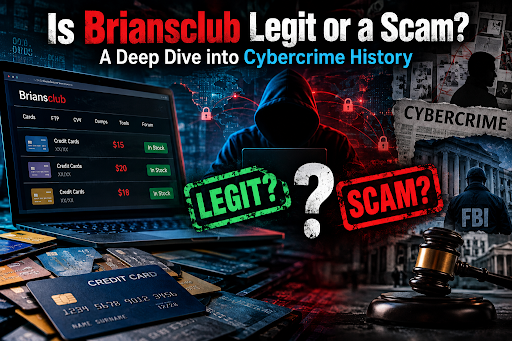
If you’ve come across the name BriansClub, Brians Club, or bclub online, you may have wondered whether it was a legitimate website, a scam, or something more serious.
The answer becomes clearer once the name is put into its historical context.
BriansClub was a criminal underground marketplace associated with the sale of stolen payment-card information. It was not a legitimate financial service, card provider, or conventional online business. Security researchers have documented substantial evidence about its operations, including millions of stolen card records and extensive transaction data.
Describing briansclub as merely a “scam” oversimplifies the nature of the operation. Unlike a typical scam, where victims are directly manipulated into handing over money or sensitive information, BriansClub functioned within a much larger underground market built around the buying, selling, and exploitation of payment data that had already been obtained through criminal means.
The platform drew significant attention in 2019 when BriansClub itself became the target of a major breach. The incident reportedly exposed information associated with more than 26 million stolen payment-card records, providing cybersecurity researchers with an unusually detailed look at the structure and activity of an illicit carding marketplace.
This article explores the documented history of BriansClub, examines its importance in cybersecurity research, and distinguishes verified information from the speculation and myths that have emerged around the marketplace over time.
What Was BriansClub?
BriansClub operated as an underground marketplace where stolen credit and debit card information was bought and sold. Researchers from NYU Tandon School of Engineering examined records linked to the site covering the period from 2015 to 2019. Their findings indicated that the marketplace had listed more than 19 million individual card numbers and brought in nearly $104 million in gross revenue over those years.
Those figures reveal the considerable size of the operation rather than a minor online fraud scheme.
BriansClub was part of a much wider cybercrime market. Payment information obtained through compromised businesses, payment systems, or other sources could move through criminal networks before reaching sellers on the marketplace. Once listed, the stolen details could be purchased by other criminals for further fraudulent activity.
It is also worth separating the marketplace from the original theft of the data. BriansClub did not necessarily obtain every card number that appeared on its site. In many cases, the information could have been stolen elsewhere and later brought into the marketplace for resale.
In many cases, the original theft could have happened somewhere else before the information entered the marketplace.
The basic process can be described quite simply:
A business or payment system is compromised → card details are stolen → the information reaches an underground marketplace → another criminal purchases it → the stolen details may then be used for fraudulent transactions.
This chain is important to keep in mind when discussing BriansClub or the term “bclub,” because the marketplace was only one part of a much broader system involving the theft, sale, and misuse of payment information.
. The marketplace was one component of a wider criminal infrastructure.
Is BriansClub Legit?
No—BriansClub was not a legitimate business or legitimate card marketplace.
The available research describes it as an underground marketplace for stolen payment-card information. NYU researchers analyzed transaction records extracted from the marketplace and characterized its sellers, customers, inventory, pricing, and finances.
The evidence therefore goes considerably beyond an anonymous internet rumor.
Researchers found:
- More than 19 million unique card numbers listed during the study period
- Nearly $104 million in gross marketplace revenue
- Approximately 97% of the inventory consisting of magnetic-stripe data
- Tens of thousands of buyers
- A substantial difference in demand between different categories of stolen information
These findings establish that BriansClub was associated with a functioning illicit marketplace rather than a conventional commercial service.
Was BriansClub a Scam?
The term “scam” can be misleading.
BriansClub was criminal infrastructure, not simply a fake website taking money from unsuspecting customers.
That does not mean every transaction was successful or that buyers necessarily received useful information. Underground criminal markets can have unreliable inventory, inactive data, disputes, refunds, and dishonest participants.
But the central business model was based on stolen financial information.
So a more accurate description is:
BriansClub was an illicit cybercrime marketplace, rather than a legitimate company or an ordinary online scam.
That distinction matters when researching the subject for cybersecurity, journalism, or SEO purposes.
Why Was It Called BriansClub?
One of the strangest aspects of the story is the marketplace’s name.
BriansClub used the name and likeness of cybersecurity journalist Brian Krebs in its marketing.
Krebs had no legitimate connection to the operation. In fact, his publication, KrebsOnSecurity, became one of the principal sources reporting on the marketplace and its 2019 compromise.
The branding appears to have been deliberately provocative.
That created an unusual situation in which the person whose identity was being exploited was also investigating and reporting on the criminal enterprise.
This is one reason searches for “Brians Club” can produce confusing results. The term can refer to the underground marketplace itself or to the extensive journalism and research documenting it.
The 2019 BriansClub Hack
The defining event in the marketplace’s history came in 2019, when BriansClub itself was compromised.
According to reporting at the time, an attacker extracted information involving more than 26 million stolen payment-card records. The database was subsequently provided to KrebsOnSecurity and shared with organizations involved in combating payment-card fraud.
The irony was hard to miss:
A marketplace built around stolen information had itself been robbed of its data.
The incident was significant for another reason. Investigators were suddenly able to examine information from inside the marketplace rather than relying only on advertisements, forum posts, or claims made by criminals.
That provided an unusually detailed window into the underground card economy.
What Did Researchers Discover?
The NYU research based on the leaked BriansClub data produced several important findings.
More Than 19 Million Cards Were Listed
The marketplace had listed more than 19 million unique payment-card numbers during the period examined.
Yet not every item in the inventory was purchased.
Researchers found that approximately 60% of the listed accounts did not attract buyers. Overall, customers purchased around 40% of the magnetic-stripe inventory.
This is an important detail because it challenges the assumption that every stolen card automatically has significant value.
The usefulness of stolen information can vary considerably.
Factors can include the issuing bank, geographic restrictions, fraud controls, whether an account remains active, and whether the information can be used for a particular type of fraudulent transaction.
Why Some Stolen Cards Were More Valuable Than Others
The BriansClub research revealed a functioning supply-and-demand system.
Researchers found that buyers appeared to favor cards associated with financial institutions they perceived as having weaker or less restrictive fraud controls. They also identified significant regional differences in demand.
This illustrates an important cybersecurity principle:
Attackers respond to incentives.
If a particular type of stolen information is difficult to monetize, demand can fall. If another category appears easier to exploit, criminals may be willing to pay more for it.
This makes underground marketplaces useful sources of threat intelligence for researchers studying how criminals adapt to security improvements.
The Role of Magnetic-Stripe Data
Approximately 97% of BriansClub’s inventory consisted of stolen magnetic-stripe data, according to the NYU study.
That finding is especially interesting in the context of EMV chip cards.
EMV technology was designed to make counterfeit payment cards more difficult to produce. However, many payment environments continued to support magnetic-stripe transactions.
NYU researchers found that even in the later period covered by their data, a substantial amount of stolen magnetic-stripe information came from cards that also had EMV chips.
In other words, introducing more secure payment technology did not instantly eliminate older attack opportunities.
Instead, criminals continued looking for weak points in the broader payment ecosystem.
BriansClub and Card-Not-Present Fraud
The research also highlighted the growing importance of card-not-present (CNP) transactions.
These are transactions in which the physical payment card does not need to be presented—for example, certain online purchases.
According to NYU’s analysis, BriansClub sold approximately 83% of its card-not-present inventory, compared with around 40% of its magnetic-stripe inventory.
That difference illustrates a basic economic principle.
Scarce information that criminals believe can be monetized effectively can command greater demand.
As physical payment security improved, researchers observed evidence that fraud incentives were shifting toward online environments.
This phenomenon is sometimes described as fraud displacement: improving security in one channel can push attackers toward another channel rather than eliminating fraudulent activity altogether.
How Much Money Did BriansClub Make?
The NYU researchers estimated that BriansClub generated approximately $104 million in gross revenue over the four years examined.
They estimated approximately $24 million in profit after accounting for supplier commissions and refunds.
Those figures should be interpreted as research estimates rather than audited financial statements.
Nevertheless, they demonstrate the scale at which an underground marketplace could operate.
The marketplace had identifiable economic components:
- Suppliers
- Buyers
- Inventory
- Pricing
- Commissions
- Refunds
- Revenue
- Profit
That is one of the most significant lessons from the BriansClub case.
Cybercrime is not always a collection of isolated hackers acting independently. In some cases, it behaves like a specialized economy.
Did BriansClub Get Shut Down?
This question requires careful wording.
The 2019 breach was not simply a conventional government seizure.
The marketplace was compromised, its database was extracted, and the information became available to researchers and organizations involved in payment-card security. Public reporting subsequently continued to track BriansClub-related activity.
Therefore, statements claiming that a particular event definitively “shut down BriansClub” should be treated cautiously unless they identify a specific law-enforcement action and supporting evidence.
A criminal marketplace can become inaccessible, change infrastructure, lose domains, or cease operating publicly without a corresponding public announcement of a formal seizure.
Likewise, investigating individuals associated with an underground market does not necessarily mean authorities have identified or arrested every person involved.
Why the BriansClub Investigation Matters
The investigation demonstrated how information obtained from criminal infrastructure can sometimes become useful to defenders.
Once the BriansClub data reached security researchers and financial organizations, it could be analyzed to identify potentially compromised payment accounts.
That creates a defensive chain:
Criminal marketplace data → threat intelligence → financial analysis → fraud detection → potential victim protection
Instead of remaining exclusively in the hands of criminals, information from the marketplace became useful for understanding and mitigating payment-card fraud.
This is one reason the BriansClub incident remains relevant to cybersecurity research years after the original breach.
BriansClub Was Not the Entire Dark Web
Another common misunderstanding is treating BriansClub as synonymous with the dark web.
It wasn’t.
The dark web encompasses many different kinds of services and communities. Some have legitimate purposes, including privacy protection and censorship circumvention. Others facilitate criminal activity.
BriansClub represented one specific part of the criminal ecosystem: the underground trade in stolen payment-card information.
That distinction is important.
The existence of a criminal marketplace does not mean the entire dark web operates in the same way, just as the existence of an illegal business on the conventional internet would not make the entire internet an illegal marketplace.
What Can Businesses Learn From the BriansClub Case?
The BriansClub investigation offers lessons that extend beyond payment cards.
Monitor for signs of compromised information
Organizations need visibility into whether customer information may have been exposed after a breach.
Treat data breaches as an ongoing risk
A breach doesn’t necessarily end when unauthorized access is removed. Stolen information can circulate for months or years.
Understand secondary markets
Security teams should consider what happens to compromised data after the original incident.
Combine cybersecurity with fraud intelligence
Technical security controls and financial fraud monitoring address different stages of the attack lifecycle.
Minimize unnecessary exposure of sensitive information
Researchers and journalists investigating criminal markets should avoid publishing victim data simply because it is available.
Responsible reporting can document an incident without creating another source of harm.
BriansClub: Scam, Legitimate Service, or Criminal Marketplace?
The evidence supports a straightforward conclusion.
| Description | Accurate? |
| Legitimate financial service | No |
| Ordinary online shopping website | No |
| Conventional scam website | Not the best description |
| Underground cybercrime marketplace | Yes |
| Marketplace associated with stolen payment-card data | Yes |
| Subject of significant cybersecurity research | Yes |
Calling BriansClub a “scam” is therefore an oversimplification.
The documented evidence shows that briansclub was an illicit marketplace associated with stolen payment-card information. Its scale was substantial enough to become the subject of academic research, investigative journalism, and financial-sector analysis.
Final Takeaway
The story of BriansClub, Brians Club, and bclub is more complicated than the question “Is it legit or a scam?” suggests.
It was not a legitimate service. But it also wasn’t merely a fake storefront designed to trick customers. It was part of an established criminal economy centered on stolen payment-card information.
The 2019 compromise made BriansClub particularly important because researchers gained access to an unusually large body of marketplace data. NYU’s subsequent analysis documented more than 19 million unique card numbers, nearly $104 million in gross revenue, and significant differences in what criminals were willing to purchase.
The case ultimately demonstrates a broader reality about cybercrime: stolen information can have an economic lifecycle. Data can move between attackers, intermediaries, marketplaces, and fraudsters before causing financial harm to individuals and businesses.
For researchers, the BriansClub case provides a rare look inside that economy. For organizations, it reinforces the importance of protecting payment data, monitoring fraud, and understanding what can happen to information after a security breach.
Most importantly, anyone researching bclub or BriansClub should distinguish documented history from sensational claims. The strongest evidence comes from academic research, investigative reporting, and verified security analysis—not anonymous advertisements or websites claiming to represent the original operation.
