


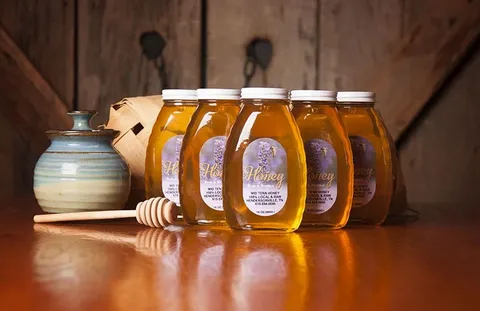
Put two jars of honey on a table. One from a local beekeeper. One from a supermarket shelf. Open both lids. Within seconds, you will notice the difference in color, clarity, and smell before you even pick up a spoon. Local honey carries the fingerprint of the landscape it came from. Store-bought honey has been processed until most of its identity is gone. The five differences below are detectable with your own eyes, nose, and tongue. They also reveal how much processing has happened between the hive and your kitchen.
What You Can See Before You Even Taste It
Three of the five differences are visual. You can spot them the moment you compare two open jars.
1. Color Tells You Where It Came From
local honey changes color from batch to batch and season to season. Spring clover honey is pale gold. Late summer wildflower honey is deep amber. Buckwheat honey is nearly black. This variation is natural and reflects the specific nectar bees collected during that harvest.
Store-bought honey looks the same in every bottle: consistent, clear amber. That uniformity comes from blending honey from multiple sources and countries until all regional character is averaged out.
2. Clarity Reveals How Much Was Removed
Local honey is cloudy. That cloudiness comes from natural pollen, wax micro particles, and propolis traces that remain after light straining. These components are part of what makes honey a functional food rather than a simple sweetener.
Store-bought honey is clear because ultrafiltration removes everything that causes haze:
- Pollen grains that identify the flower source and geographic origin
- Wax particles that carry flavor compounds
- Propolis traces with antimicrobial properties
If honey looks polished and transparent like cooking oil, it has been heavily filtered.
3. Texture and Crystallization Show Whether It Is Real
Real honey crystallizes over time. Glucose molecules naturally separate from water and form solid crystals, especially in raw, unheated honey. Local honey often arrives creamy or semi-solid and continues to thicken in the pantry. This is a sign of authenticity.
Store-bought honey stays perfectly liquid for months or years because:
- Pasteurization dissolves the seed crystals that start crystallization
- Filtration removes pollen grains that act as nucleation points
- Some brands add syrups to prevent any texture change
Honey that stays liquid for long periods may have been pasteurized or filtered, though crystallization speed also depends on the nectar source.
What You Taste and Smell When You Open the Jar
The remaining two differences hit the moment you bring the jar close to your nose or put a spoonful on your tongue.
4. Aroma Is the Fastest Quality Test
Open a jar of local raw honey, and the scent fills the room. It may be floral, earthy, slightly waxy, or warm and sweet, depending on the flower source. These aromas come from volatile organic compounds in nectar and enzymes bees add during production.
Store-bought honey carries a faint scent at best. Pasteurization drives off heat-sensitive volatiles. Filtration strips the pollen and propolis that add layered aromatics. Blending dilutes whatever remains. A strong, complex aroma means minimal processing. A weak or absent one means the honey has been heated, filtered, or both.
5. Flavor Complexity Separates the Two Instantly
Local honey tastes like the landscape. A jar from lavender fields carries floral top notes. One from eucalyptus trees has a medicinal depth. Wildflower blends shift flavor with the season. This complexity comes from the diverse nectar sources and the enzymes and pollen that survive minimal processing.
Store-bought honey tastes flat:
- Heat pasteurization breaks down the volatile compounds that create flavor layers
- Blending from multiple origins cancels out any distinctive character
- Ultra filtration removes pollen and micro particles that carry terroir
The result is uniform sweetness with no depth. It works as a sweetener but delivers none of the sensory richness that made honey a valued food for thousands of years.
What These Differences Actually Tell You
The five sensory gaps between local and store-bought honey map directly to processing decisions made between the hive and the shelf.
Decoding What You See, Taste, and Smell
| What You Notice | What It Means |
| Color varies batch to batch | Honey is single-origin, not blended |
| Cloudy with visible particles | Pollen and propolis intact, lightly strained only |
| Crystallizes over time | Raw, unheated, no syrups added |
| Strong, complex aroma | Volatile compounds preserved, minimal heat exposure |
| Layered, floral flavor | Enzymes and nectar diversity survived processing |
Every one of these indicators points to honey that was handled minimally. The absence of any of them points to heavy processing that removed the qualities people pay a premium for.
Takeaway
The differences between local and store-bought honey are not hidden in lab tests. You can usually spot them in the jar. Color variation, slight cloudiness, natural crystallization, and a noticeable aroma all point to honey that has been handled minimally after leaving the hive. When honey looks clear, smells faint, and tastes uniformly sweet, it often means the product has been heavily filtered, heated, or blended.
Understanding these signals makes it easier to judge what you are actually getting when you buy a jar of honey. Instead of relying on labels alone, you can use simple sensory clues to tell how much of the honey’s natural character has been preserved.
For example, honey sourced from small regional harvests, such as the batches offered by Smiley Honey, typically keeps these natural traits intact. Because it is collected and handled in small quantities, each jar reflects the flowers bees visited during that particular season. As a result, color, aroma, and texture can vary slightly from one harvest to the next, which is exactly what real, minimally processed honey tends to do.
